What you’re missing: The Commandments of exercise.
Essential advice for putting together a successful workout program and smashing through the plateaus when your workout becomes stagnant.
 |
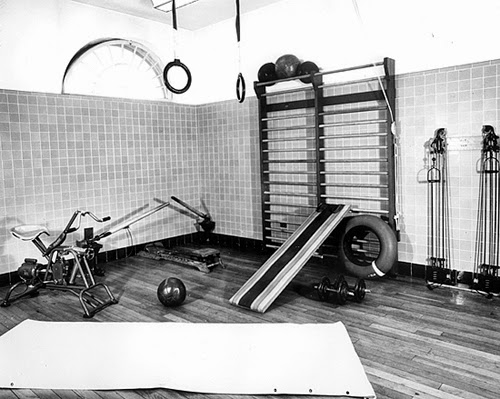
| It sure looks like cross-fit in some ways |
In parts one and two we covered some of the issues that can interfere with consistency as well as went over the “Commandments of training”. In this final installment we will finish talking about the essential concepts of exercise so you can train smart and “MOVE TO LIVE & LIVE TO MOVE”
In review the basic tenets are overload, rest, adaptation, specificity and reversibility. We covered the first two last time so lets get to the rest.
Specificity: You reap what you sow
 |
| Anyone want to guess what Micheal Johnson’s adaptations were? |
If you sprint, you develop big quads. If you work with your hands, you develop big forearms. Humans are adaptable creatures, almost everything we are exposed to eventually we adapt to. Whether it’s a hot bath or a loud room at a party or concert, what your initially exposed to eventually becomes “background noise”. Fitness training is no different, it shapes and molds each one of us (activity dependent), and if done enough, it becomes a bit routine. The S.A.I.D. principle (a common rehab/fitness concept) states exactly that, we specifically adapt to the imposed demands placed upon us; it’s the reason the stone masons forearms are so big and strong or the Kenyan marathoner who seems built for what he does. In fact the Kenyan IS built for what they do, and is the result of many generations of demands imposed. These individuals commonly have crossed large desert distances for generations and have become efficient at doing so.
Here’s a thought; If this is true, why do we train our high school pitchers in the weight room? We’re training them to be slow and plodding, a pitcher’s biggest need is speed!
 |
| The perfect marathon machine crafted over generations |
Adaptation: It goes both ways…
The body’s ability to learn, adapt and improve allows us greater ability, but it also causes our progress to plateau. Doing the same exercise or activity week in week numbs the physiologic response that is responsible for muscle growth, hormonal adaptations and the enzymatic changes that gives us better endurance (better oxygen delivery, improved energy systems). If it isn’t broke, don’t fix it does not apply in regard to adaptation, while it makes things easier for us, it also makes us comfortable. In fitness we need to be challenged and constantly pushed.

The concept of reversibility is one we can all sympathize with, it’s the idea that our gains made through exercise are lost at a rate of 3:1. In other words If we worked out for one month it would take our body three months to loose or “forget” the benefits that came with said exercise program. But like adaptation, it goes both ways! The concept also states that the de-trained athlete will quickly recover the lost gains due to inactivity vs. someone who was completely uninitiated. So, while it’s true that if you don’t use it you loose it, it’s also true that after you loose it it’s easier to get it back compared to someone who never had it to start. To avoid reversal of gains simply perform one set to complete fatigue of each body part once a week!To summarize this series, here are some do’s and don’ts;
Do Increase you weight, reps, time or sets 10% consistently
Do Get your vitamins from whole foods and stay hydrated
Don’t Drink alcohol if you’re trying to get in better shape
Do address post muscle workout soreness with active recovery techniques
Don’t get stuck doing the same routine for longer than 4 months
Do exercise the target muscle to fatigue
Don’t completely stop, if need be maintain with one set a week
Do train in a specific manner if you are an athlete with specific needs (i.e. baseball pitcher)
Don’t just sit there, I just gave you the road map, now get out there and Live to move and move to live!
Please let us know you visited our blog by liking, commenting & sharing.
 Dr. Serafim is a Rehabilitation and a Strength and Conditioning Specialist. He lives and works in the Exton PA area and has devoted himself to furthering his understanding of movement related disorders. He teaches continuing education and operates a private practice. More information can be found at Kinetx.org and feel free to like us at our facebook page.